OCA Research Grant Program: 2026 Funding Cycle Now Open

The Oil Containment Association Research Foundation is pleased to announce the opening of the 2026 Research Grant Program. The Foundation will award up to $450,000 in research grants to support scientific advancement in oil containment technology, environmental remediation, and regulatory policy development.

2026 Research Priorities

The Foundation has identified four priority research areas for the 2026 funding cycle:

  1. Advanced Containment Materials: Development and testing of next-generation coating and liner materials with enhanced chemical resistance, environmental compatibility, and lifecycle performance
  2. Spill Detection Technologies: Sensor-based and remote monitoring systems for early spill detection in secondary containment areas
  3. Environmental Fate and Transport: Studies examining the environmental behavior of petroleum hydrocarbons in various soil and groundwater conditions to inform containment design
  4. Regulatory Efficacy: Analysis of the effectiveness of existing containment regulations in preventing environmental harm, and recommendations for policy improvements

Grant Categories

Major Research Grants: Up to $100,000 for 2-year projects conducted by accredited universities or research institutions. Four grants will be awarded.

Industry Innovation Grants: Up to $50,000 for collaborative industry-academic projects with practical application focus. Four grants will be awarded.

Student Research Awards: Up to $15,000 for graduate student thesis research projects. Four awards will be made.

Application Process

Applications are accepted through June 30, 2026. Awards will be announced September 1, 2026. Applications must be submitted through the OCA Research Foundation grant portal at oilcontainment.org/research-grants. Letters of intent are required by May 15, 2026.

OCA Technical Committee Update: Winter 2026 Meeting Summary

The OCA Technical Committee held its Winter 2026 meeting on January 23rd in Denver, Colorado, with 34 committee members present and an additional 28 participating virtually. This summary covers the key topics discussed and action items assigned.

Attendance

The meeting was chaired by Technical Committee Chair Dr. Patricia Wade, P.E. In attendance were representatives from 22 member organizations including major oil producers, independent operators, environmental consultants, and containment equipment manufacturers. EPA Region 8 sent a representative as a non-voting observer.

Agenda Item 1: Polyurea Standard Update

Committee members reviewed the draft update to OCA Standard 2024-P (Polyurea Coating Performance Standards for Oil Containment Applications). After extensive discussion, the committee voted 31-3 to approve the following amendments:

  • Minimum Shore A hardness increased from 85 to 90 for vertical application surfaces
  • New requirement for manufacturer-documented recoat windows
  • Expanded chemical resistance testing requirements to include bio-diesel blends
  • Addition of low-temperature flexibility test at -60°F

The updated standard will be published in the Spring 2026 edition of OCA Technical Bulletin.

Agenda Item 2: Foam Core Material Research Results

Dr. David Chen presented the results of a 24-month field study comparing four foam core materials used in portable containment berms. The study evaluated compression recovery, UV degradation resistance, and dimensional stability across 12 test sites in four climate zones.

Key finding: Closed-cell polyisocyanurate foam significantly outperformed open-cell polyurethane in all metrics, with 94% dimensional retention after 24 months versus 71% for open-cell formulations. Full results will be published in the OCA Journal of Containment Technology (Spring 2026 issue).

Agenda Item 3: New Member Training Program

Member Services Director Sarah Williams presented a proposal for an expanded OCA Certified Containment Specialist (CCS) program. The updated curriculum adds two new modules: Advanced SPCC Planning and Digital Inspection Technologies. The program will launch in Q2 2026 with a target enrollment of 200 students in the first cohort.

Next Meeting

The Spring 2026 Technical Committee meeting is scheduled for April 17th in Houston, TX, hosted by member organization Gulf Coast Environmental Solutions. Registration opens March 1st via the OCA Member Portal.

Polyurea vs. PVC Liners: A Technical Comparison for Containment Applications

Choosing the right liner material for your secondary containment system is a critical decision that affects long-term performance, regulatory compliance, and total cost of ownership. This article provides a technical comparison of the two most widely used containment liner materials: polyurea coatings and PVC liners.

Material Properties Overview

Polyurea

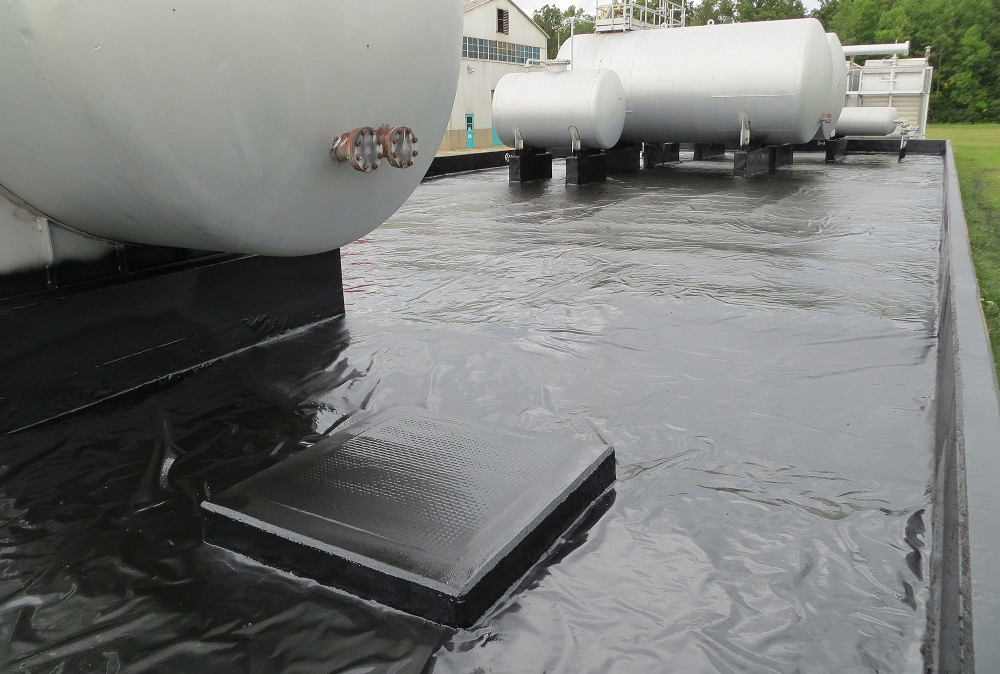
Polyurea is a type of elastomer formed by the reaction of an isocyanate component and a resin blend component through step-growth polymerization. For containment applications, spray-applied polyurea coatings are applied directly to foam or substrate surfaces, creating a seamless, monolithic membrane.

Key properties:

  • Shore A hardness: 85-95 (tunable)
  • Tensile strength: 2,000-4,500 psi
  • Elongation at break: 300-600%
  • Temperature range: -60°F to 350°F
  • Chemical resistance: Excellent to petroleum hydrocarbons, moderate to strong acids
  • UV resistance: Good to excellent (with UV stabilizers)

PVC (Polyvinyl Chloride)

PVC liners for containment applications are typically reinforced fabric panels welded together at seams. They are available in thicknesses from 20 mil to 80 mil for containment applications.

Key properties:

  • Tensile strength: 200-400 lb/in (depending on thickness)
  • Temperature range: -10°F to 150°F (unreinforced)
  • Chemical resistance: Good to petroleum hydrocarbons, poor to aromatic solvents
  • UV resistance: Moderate (degrades significantly over 3-5 years without UV stabilizers)

Performance Comparison

Seam Integrity

Polyurea wins decisively. Spray-applied polyurea creates a seamless coating with no joints or seams. PVC liners require heat-welded seams at every panel junction, which are the primary failure points. In our field studies, over 80% of PVC liner failures occurred at seams.

Puncture Resistance

Polyurea is significantly more puncture-resistant. Standard containment polyurea resists puncture from typical job site debris (rocks, equipment feet) that routinely penetrate 40-mil PVC. For vehicle drive-over applications (foam berms), polyurea is the only viable choice.

Temperature Performance

Polyurea significantly outperforms PVC in both extreme cold and heat. PVC becomes brittle below 10°F and can crack under flex loading. Polyurea remains flexible at temperatures as low as -60°F, making it the only appropriate choice for Arctic and sub-Arctic applications.

Cost Comparison

PVC has lower upfront material costs ($0.40-$1.20/sq ft for 40-mil PVC vs. $3-8/sq ft for applied polyurea). However, when total lifecycle costs are considered over a 10-year period, polyurea typically proves more economical due to lower maintenance, repair, and replacement costs.

OCA Recommendation

For portable foam berm containment systems, drive-through containment areas, and cold-weather applications, OCA recommends polyurea-coated systems. For large-area liner applications with controlled environments and lower mechanical stress, properly installed PVC can be a cost-effective solution when budget constraints preclude polyurea.

Loading...

Get Free Expert Tips

Subscribe for oil containment best practices, regulatory updates & product news.

No spam. Unsubscribe anytime.