Solutions

Oil spill containment that holds the first ten minutes

Containment is a system, not a product: a primary vessel that should not leak, a secondary barrier that catches it when it does, and a response capability for everything that gets past both.

0Gallons that trigger SPCC
0Of largest tank, minimum
0Design storm allowance
0Gallons that make a release reportable
The four layers

Where containment actually happens

Most reportable releases are not caused by a missing system. They are caused by one layer being treated as if it were all four.

Primary containment

The tank, drum, pipe or vessel itself. Corrosion control, integrity testing and overfill prevention live here. Every gallon kept inside primary containment is a gallon nobody has to chase.

Secondary containment

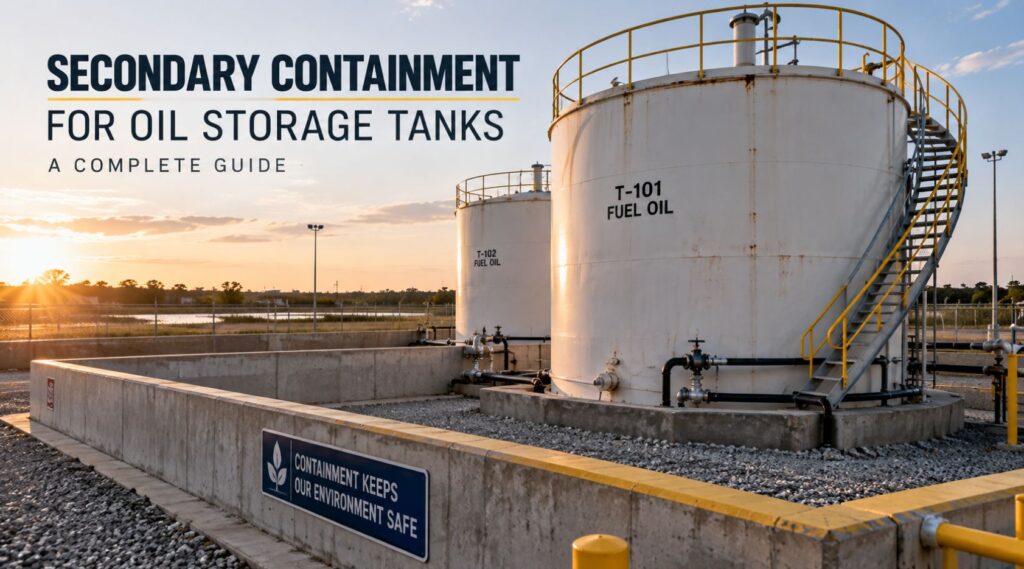
The dike, berm, liner or vault that catches a primary failure. Sized, not guessed: 110% of the largest vessel plus a design rainfall allowance.

Tertiary and site controls

Grading, curbs, valved outfalls and oil-water separators that keep a release inside the property line when the secondary barrier is overtopped.

Response capability

Trained people, staged sorbents and a plan that names who calls the National Response Center. Equipment nobody has drilled with is decoration.

Choosing

Match the system to the exposure

The right answer changes with how long the oil sits, what drives over it, and whether the area sees weather.

Fixed tanks above 1,320 gallons aggregate need engineered secondary containment with a demonstrated capacity calculation. Options, roughly in order of cost and durability:

MethodTypical lifeSeamsDrive-overBest for
Spray polyurea over concrete15-25 yrNone✓Permanent tank farms, vaults
Reinforced geomembrane liner10-20 yrWelded✗Large earthen basins
Concrete dike, uncoated20 yr+Joints✓Low-permeability soils, mild climates
Prefabricated steel pan20 yr+Welded✗Single small tanks
Sizing tool

How much containment do you actually need?

Enter the largest vessel and the footprint you have. The tool applies the 110% rule and adds a rainfall allowance.

Secondary containment sizing

SPCC sizing for a single-tank containment area — 110% of the largest vessel plus rainfall freeboard.

Required capacity (110%)—
Rainfall allowance—
Net available capacity—
Minimum wall height—

Planning aid only. 40 CFR 112 requires a sized, engineered design; most SPCC plans must be certified by a licensed P.E.

From the library

Further reading

Oil Containment Association

Not sure which layer is failing?

Send us the site layout and the tank schedule. The OCA technical committee reviews member submissions at no cost and will tell you plainly what is missing.